Chapter #21(of 24)
Suffering Is Not a Puzzle to Solve

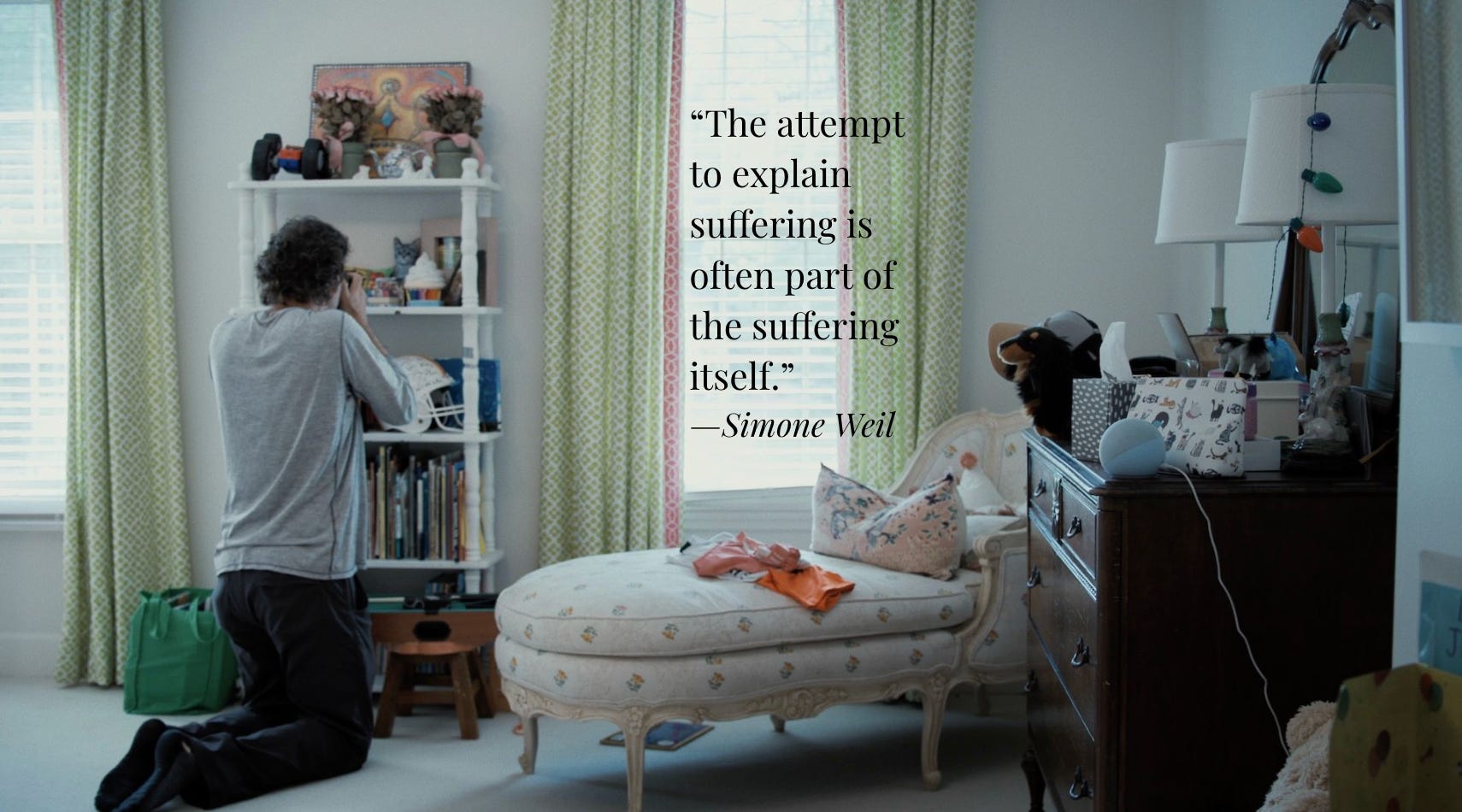
We often treat suffering as a problem of logic, a puzzle that, if we could only find the right piece, would finally make sense. We search for the “why” as if explanation could act as a cure, as if understanding might soften the blow. But some losses do not yield to reason. They are not puzzles to be solved; they are realities to be lived.
We assume that meaning requires understanding—that if we could explain the loss, we could somehow carry it more easily. But explanation and meaning are not the same. Explanation satisfies the mind; meaning steadies the heart. One seeks closure. The other makes endurance possible.
A haunting illustration appears in Steve Hartman’s documentary All the Empty Rooms. The film does not offer resolution. It offers witness. Hartman visits the homes of parents whose children were taken in school shootings. In these homes, time has been allowed to stop. Bedrooms remain untouched. Beds unmade, homework half-finished, shoes waiting by the door. Everything is held in quiet suspension.
To an outsider, these rooms might appear frozen in grief, as though the families are refusing to move forward. But that interpretation misses what is actually happening. These parents are not waiting for the room to be filled, nor are they searching for an explanation that will make the loss acceptable. They are choosing how to live with what cannot be explained.
They are not solving the loss.
They are staying with the love.
The rooms are not monuments to despair; they are acts of stewardship. A refusal to let the violence of the ending erase the reality of the life that came before it. Meaning is not being extracted from the tragedy. It is being protected in its aftermath, not through answers, but through presence.
The cultural response to Hartman’s work is telling. It was honored not because it resolved anything, but because it refused to turn away. We recognize, even if we rarely articulate it, that there is dignity in this kind of staying. That optimism, at its most mature, does not rush to explain. It remains. Like a clinician who cannot cure but refuses to abandon, or a family who cannot repair what was taken but refuses to forget, meaning is not found by looking away. It is found by staying in the room.
If these families show us how to inhabit private silence, Father Gregory Boyle shows us how to inhabit a public one. For decades, working among gang-affected communities in Los Angeles, Boyle has stood at the gravesides of young men and women whose lives ended far too soon. He does not offer explanations. He offers presence.
He speaks of “the jurisdiction of the heart,” where the goal is not to fix what is broken, but to be moved by it. His optimism does not appear as solutions or outcomes. It appears as accompaniment, a steady willingness to remain close to suffering without trying to resolve it into something neat or manageable. He shows up to the next funeral, says the name, and stays. In that staying, something shifts. The question is no longer Why did this happen? but How will we remain human in its wake?
Presence becomes a form of meaning that does not require explanation.
This is the invitation hidden inside suffering. Not to solve it or justify it, but to refuse to abandon love when understanding fails. When we insist on explanation, we often delay engagement. We stand at a distance, waiting for clarity before we allow ourselves to feel, to act, to remain. But life does not always offer clarity. Some realities arrive without interpretation, and still, we must live within them.
The future does not belong to those who can explain suffering. It belongs to those who refuse to abandon meaning in its presence, not by solving it, but by staying.
In the room.
At the graveside.
Beside one another.
Until love, not explanation, has the final word.