Chapter #20(of 24)
Belonging Begins with Initiative

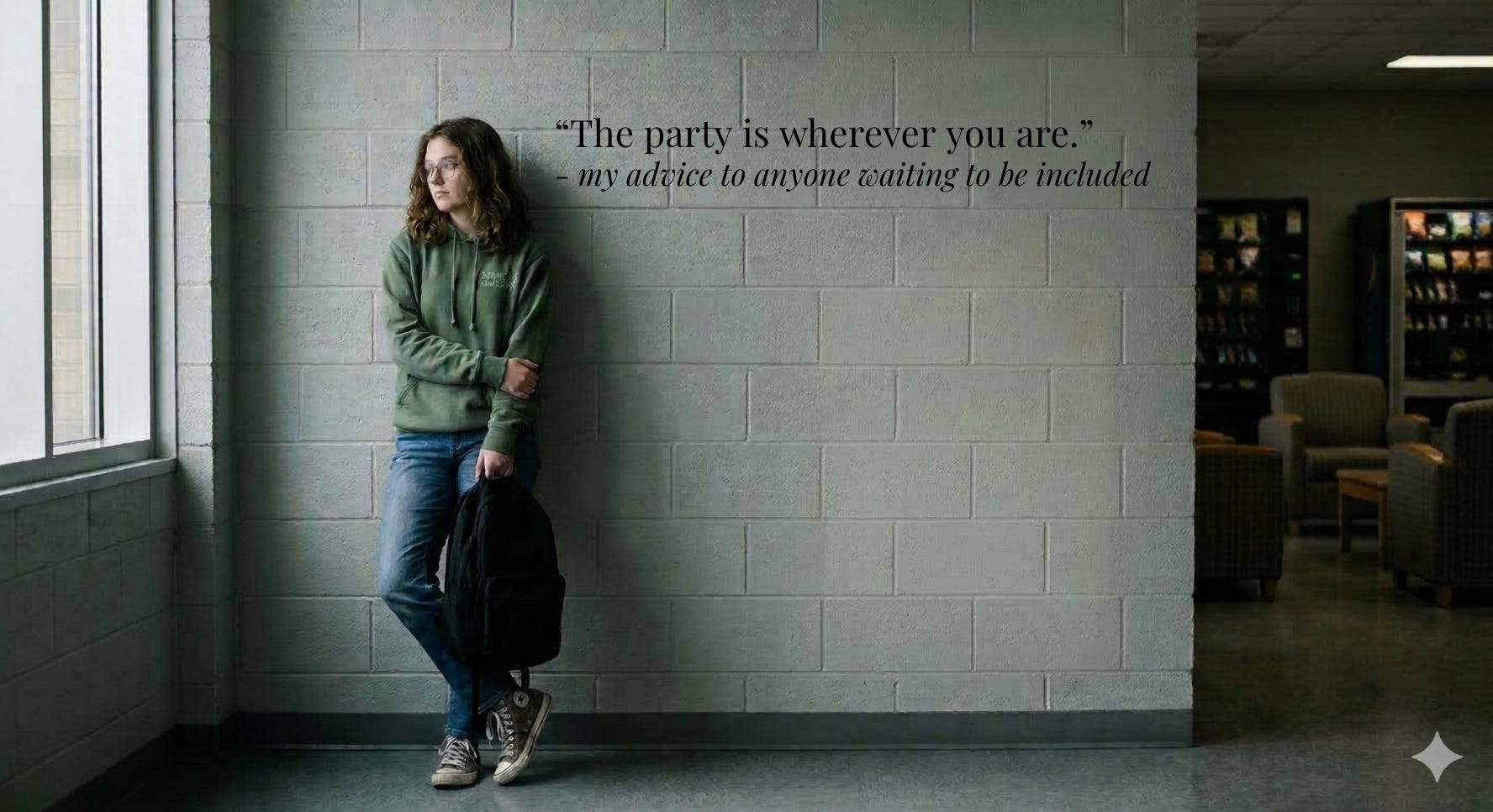
Community is often imagined as something we enter. A circle we are invited into. A room where the music is already playing and we hope someone notices us standing near the door. Much of modern social life quietly reinforces this expectation. We wait for signals. We scan the room. We wonder where we fit.
But life eventually teaches a different lesson. Belonging rarely arrives as an invitation. More often, it begins as initiative.
Over the years, I have often found myself offering unsolicited advice to high school students preparing to leave for college, motivated by a pattern I have repeatedly observed. Again and again, I have watched capable, accomplished students arrive on campus underprepared for the basic rhythms of independent living and the social navigation that follows. Many are excited about the opportunities ahead, but beneath that excitement there is often a quieter uncertainty—how to initiate, how to connect, how to find their footing without the familiar scaffolding of home. Campuses are full of possibility, yet the first weeks can feel awkwardly unstructured. Friendships have not yet solidified. Everyone is new. Everyone is nervously scanning the landscape for signs of where they belong.
When those conversations arise, I offer a simple piece of advice.
“The party is wherever you are.”
The sentence sounds playful, but its meaning is practical. Waiting to be included is a fragile strategy for belonging. A sturdier approach is to become the starting point of connection yourself. Introduce people. Suggest the walk across campus. Invite someone to lunch after class. These gestures are small, but they change the geometry of social life. Instead of orbiting around existing circles, you begin creating one.
Belonging behaves less like a club and more like a campfire. Someone gathers a few sticks and lights the match. Others gradually drift closer to the warmth.
My mother practiced a version of this principle in a way that was both ordinary and profoundly wise. Later in her career, while working as an occupational nurse at AT&T in San Francisco, the office followed a birthday tradition that was slightly unusual.
You brought the treats on your own birthday.
At first glance the rule seems backwards. Shouldn’t coworkers be the ones remembering and celebrating you? Yet the policy contained a small but powerful insight about human nature. Waiting for others to notice you places your sense of belonging at the mercy of their memory and attention. By bringing the treats yourself, the celebration always happened. More importantly, you became the one who created the moment of shared enjoyment.
Community did not depend on whether others remembered.
It happened because someone started it.
This same principle appears at much larger scales as well. The chef and humanitarian José Andrés offers a striking example. After hurricanes, earthquakes, and wildfires, Andrés often arrives in devastated communities before large organizations have fully mobilized their response. His nonprofit, World Central Kitchen, does not begin with elaborate plans or complex logistics.
It begins with food.
Someone sets up a table.
Someone lights a stove.
Someone starts cooking.
Soon volunteers appear. Local residents bring ingredients. Strangers begin talking while waiting in line. In places where disaster has fractured normal life, a sense of community quietly begins to reassemble around a shared meal. The remarkable part is that the community did not exist beforehand. It forms because someone began the process.
Modern culture sometimes treats belonging as if it were a scarce resource controlled by gatekeepers. Social media amplifies this perception by displaying popularity in visible numbers—followers, likes, invitations, rankings. The result is a subtle but persistent anxiety that meaningful community exists somewhere else, just beyond our reach.
Yet the deeper truth is that human connection rarely emerges from perfect conditions. It grows from repeated acts of hospitality. A conversation begun. A table extended by one more chair. An invitation offered even when the response is uncertain.
Over time these gestures accumulate. The neighbor you greet each morning becomes a familiar presence. The occasional dinner becomes a tradition. A handful of acquaintances gradually turns into a circle of friends. Community, after all, is a long game. It forms not from spectacular moments but from steady continuity.
Optimism plays an essential role in this process. Not the naïve optimism that assumes every invitation will be welcomed, but the steadier form that understands connection is worth attempting even when outcomes are uncertain. Some invitations will be declined. Some gatherings will feel awkward. Some efforts will fade.
That is simply part of the mathematics of human life.
But the long game favors the people who keep setting the table.
In the end, belonging is less about discovering the perfect community than about participating in its creation. The people who experience the richest sense of connection are rarely those who waited for the perfect invitation.
They are the ones who quietly assume the gathering can begin wherever they happen to be.
Because in the long run, community does not form around perfect circumstances.
It forms around the people who decide the party has already started.